Super Great Cleaning Services
Good Office Cleaning in Petaling Jaya Goes Beyond the Floor
Judge an office clean by examining complete objects: meeting-table edges, chair frames, both faces of internal glass and the inside of pantry bins. These details reveal more than a shiny floor.
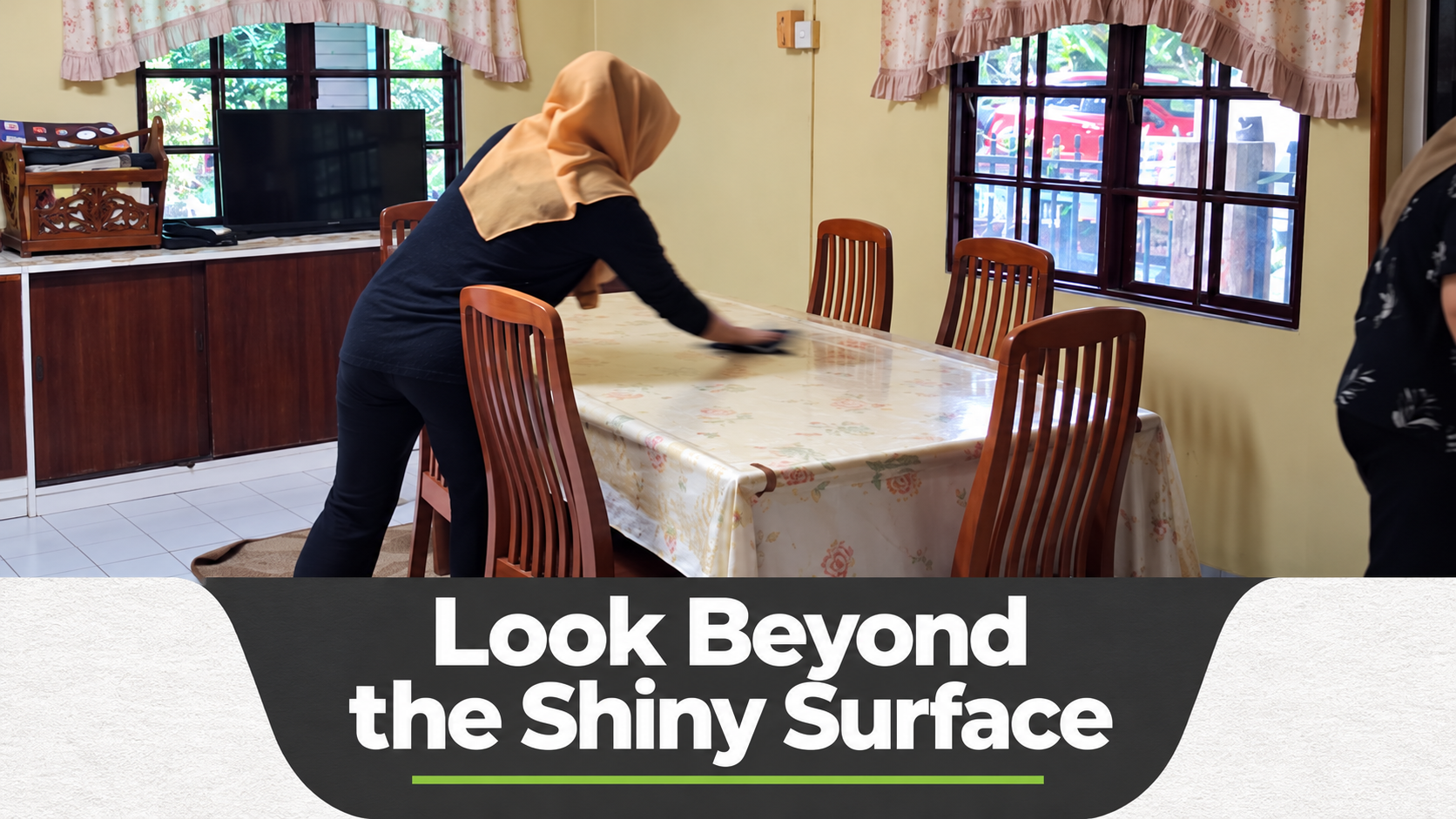
Judging an office clean by the open floor is a common mistake: a bright reception area can distract from greasy chair arms, crumbs beneath a meeting-table edge and residue inside bin lids. To assess office cleaning in Petaling Jaya, inspect a few complete objects, including their edges, contact surfaces and bases. You'll learn more from a table and two chairs examined closely than from a quick glance across every room. Super Great Cleaning Services provides office cleaning in Petaling Jaya and Ara Damansara.
Sit down before judging a meeting table
Start at seated height. Overhead lighting can make a tabletop look evenly clean, while light from a window reveals a narrow greasy band where hands rest. Look along the rounded edge and the joins between table sections; biscuit crumbs can remain in those gaps after the broad centre has been wiped.
Next, look below the top. A modesty panel facing the seats collects shoe marks, while the horizontal foot of a pedestal can hold debris beyond the reach of ordinary floor cleaning. A quick pass across the tabletop reaches neither.
Take a six-seat meeting room in PJ. Straight chairs and an empty table make it look ready for visitors, but fingers curling beneath the table lip may meet residue that nobody sees from the doorway. That's the part most people skip. Compare the centre, edge and base of the same table to judge whether the whole object received attention.
Chair arms tell on a quick once-over
Office chairs combine several materials and awkward shapes. A polyurethane arm pad, woven seat and mesh back each reveal different things: hand oils on the arm, crumbs beside the seat piping and lint caught where mesh meets its frame. Looking only at the seat cushion misses most of that story.
Choose one frequently used chair and examine these three places:
- Armrests: check the inner faces and undersides where fingers curl around the pads. The top can look clear while those less visible surfaces retain greasy marks.
- Seat-to-back join: look into the narrow gap and around the cushion piping. Crumbs can lodge there without being obvious across the broad seat.
- Five-star base: examine the horizontal spokes and the forks around the caster wheels. A clean floor beneath the chair doesn't establish that these surfaces have been cleaned.
Glass needs a view from both sides
A glass door can look clear straight on and reveal long smears when you move sideways. Reflected daylight makes uneven residue easier to see, especially against a darker room beyond the glass. Walk a few steps along the panel rather than judging it from one fixed position.
Inspect both faces. Fingerprints near a push plate may be on the opposite side from the one you're examining, so repeated wiping of the near face won't solve them. Check around handle mounting points too; the clear centre is usually easier to reach than the narrow spaces beside the fittings.
Finish at the lower rail and corners. Small runs of cleaning liquid can collect along the bottom frame, and a cloth may leave a narrow untouched strip beside a seal. On a meeting-room partition, these finishing details are easier to judge before chairs and bags obscure the lower glass.
A fresh bin liner can hide yesterday's mess
An empty pantry bin looks reassuring, but the bag covers much of the container. Once an empty liner is lifted out, look for dried drink residue on the inner bucket and debris gathered in its bottom crease. A small leak from a takeaway cup can leave a brown patch beneath an otherwise tidy bag.
The lid deserves its own look. Coffee splashes can reach its underside, while food residue can collect around the hinge and rim. On a pedal bin, inspect the pedal recess and the area where the lid meets the body; replacing the liner doesn't reach either.
If a bin has been washed, its interior should be dry before a fresh liner goes in. Water trapped beneath the bag can collect unseen at the bottom. Fragrance is a poor inspection tool here: the useful clues are the condition of the bucket, lid and surrounding floor.
Frequently asked questions
How can I check office cleaning without touching every surface?
Choose a small sample of heavily used objects, such as a meeting table, shared chair and pantry bin. View glossy surfaces at an angle to daylight, then look beneath edges and around fittings. This gives you a more useful picture than checking only broad, easy-to-reach surfaces.
Should office chair wheels be taken apart for routine cleaning?
Routine surface cleaning can address the exposed chair base and accessible caster housings while leaving the assembly intact. Hair wound around an axle or a wheel that no longer turns freely may require separate maintenance. Follow the chair manufacturer's instructions before removing casters or opening mechanisms.
Why does a glass office door still look smeared after cleaning?
Uneven cleaning residue becomes more visible in reflected light, and fingerprints may remain on the opposite face of the door. Examine both sides from several angles, including around handle fittings. A drip along the lower frame is another sign that the finishing pass needs attention.
Does a fresh smell mean the office pantry is clean?
Fragrance doesn't tell you whether spilled drinks remain beneath a bin liner or food residue is caught under the lid. Inspect the removable bucket, lid rim and hinge area directly. A clean-looking bag and a pleasant scent can coexist with residue hidden underneath.
Use one meeting table, one chair, one glass panel and one pantry bin as your inspection sample. Before booking, ask whether those detailed surfaces are included so you're comparing cleaning services against the result you actually want.
Related articles: Part-Time Maid Service in Petaling Jaya: Five Details Behind a Better Clean · What’s the Best Order for House Cleaning in Petaling Jaya?